
Going wedding dress shopping with your daughter can be a lovely experience.
However, it can also bring up money, body confidence, different tastes and expectations neither of you has discussed.
Add several guests and a non-refundable purchase, and it is easy for the appointment to feel more pressured than either of you expected.
The most helpful thing you can do is make it easier for your daughter to work out what she wants.
That may mean giving an honest opinion, asking practical questions or simply allowing her to think without filling every silence.
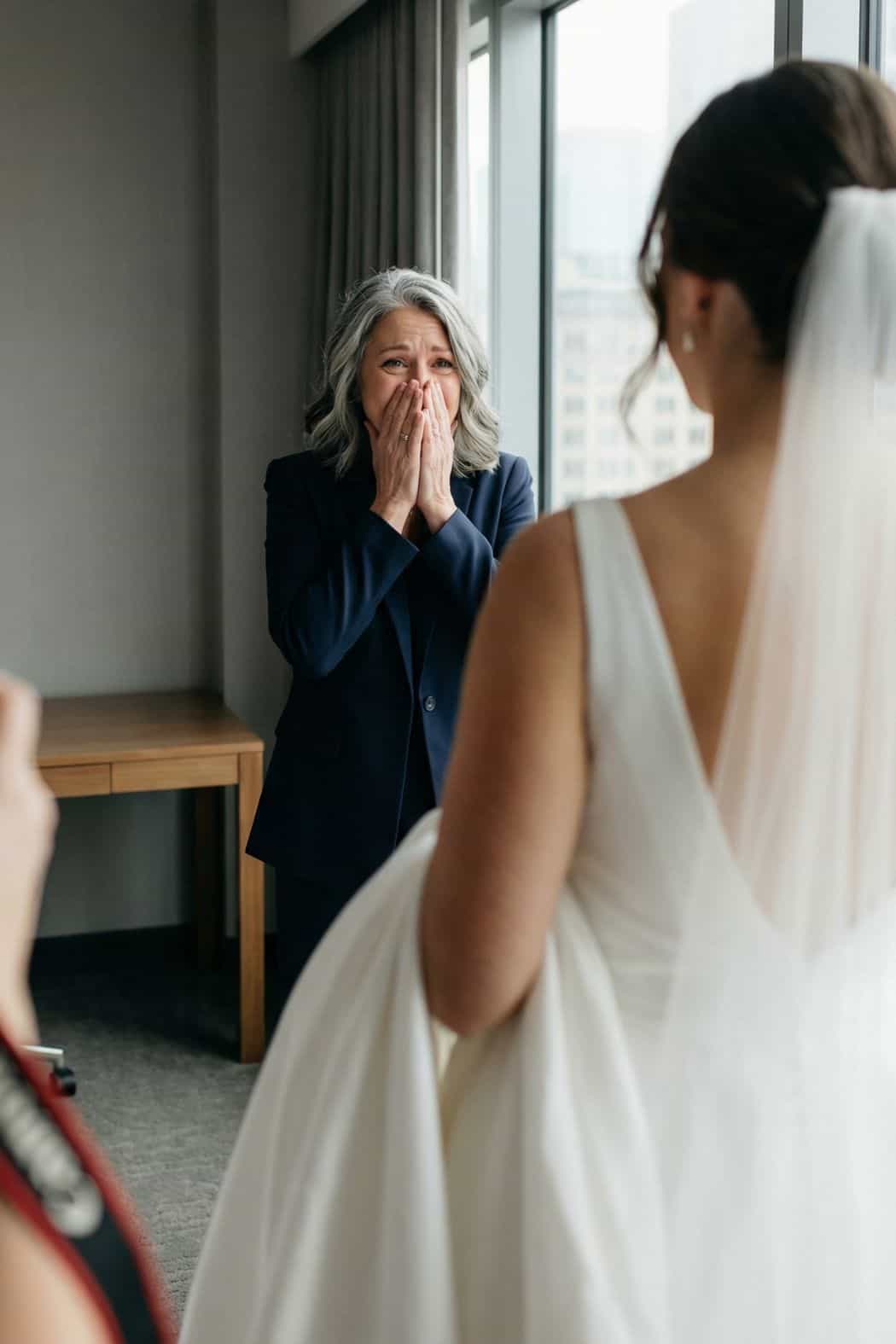
Before the Appointment, Ask What She Needs From You
Do not assume you both have the same idea of what dress shopping will look like. You may have imagined helping her choose between dresses, while she may want to make the decision herself and have you there for support.
Ask her directly:
“Would you like honest opinions, practical help or mainly encouragement?”
It is also useful to know whether this is an exploratory appointment or one where she hopes to buy. She may be trying different silhouettes for the first time, revisiting a shortlist or arriving with a very specific dress in mind.
Talk briefly about:
- The budget
- What styles she wants to try
- Whether she wants photographs
- Whether she wants you to ask the stylist practical questions
- Anything she does not want discussed, particularly weight or body shape
- Whether she plans to visit several boutiques
If she asks you to attend but does not want opinions unless requested, respect that. Being included in the appointment does not necessarily mean helping to select the dress.
Who Should Attend Wedding Dress Shopping?
Your daughter should invite the people who make her feel comfortable and able to think clearly. That might be just you, a few close relatives or friends, or nobody at the first appointment.
Mothers, stepmothers, future mothers-in-law, sisters and bridesmaids do not all have to attend. Boutique guest limits may make that impossible, but a smaller group can also prevent the appointment from becoming a debate between several different tastes.
Check the boutique’s rules before anyone is invited. Confirm:
- The number of guests allowed
- Whether children can attend
- Whether photographs and video calls are permitted
- How long the appointment lasts
- Whether accessibility or extra privacy can be arranged
Do not invite another relative on your daughter’s behalf or tell someone that she will probably include them. That creates pressure before she has made her own decision.
When There Are Several Mothers or Difficult Family Relationships
Different maternal figures do not need to attend the same appointment. Your daughter might include different people at an initial appointment, a shortlist visit, accessory shopping or alterations.
Separate appointments may be more comfortable when parents are divorced, relationships are tense or one person is likely to dominate the conversation. If you are attending with someone you do not get along with, keep the focus on your daughter. The appointment is not the place to compete over who knows her best or whose opinion carries more weight.
If you live too far away to attend, ask whether your daughter would like a video call for part of the appointment. Let her and the stylist decide when that would be least disruptive rather than expecting to remain on screen throughout.
Agree on the Budget Before She Tries On Dresses
If you are paying for some or all of the dress, be specific about the amount before shopping begins. “I’ll pay for your dress” can mean very different things to each of you.
Agree on:
- Your maximum contribution
- Whether it includes alterations
- Whether it also covers a veil or accessories
- Who will pay the deposit and remaining balance
- What happens if her preferred dress costs more
- Whether there are any conditions attached to the money
The price on the dress may not be the final cost. Alterations, delivery, steaming, storage and accessories may be separate. Ask the boutique what is included so you are comparing the real totals.
Do not encourage her to try dresses well beyond the budget “just for fun” unless everyone is genuinely comfortable with that possibility. Falling in love with an unaffordable dress can make every realistic option feel disappointing afterwards.
Paying for the dress allows you to set a financial limit. It does not give you the final choice or guarantee a place at every appointment unless that was openly agreed before the contribution was offered. New conditions should not appear once she has found a dress.
Before paying a deposit, make sure your daughter understands:
- Whether payments are refundable
- When the balance is due
- The expected delivery date
- Which size is being ordered
- What alterations the boutique expects may be needed
- What happens if the wedding date or order changes
You do not need to take over the purchase, but you can help slow the moment down enough for her to understand what she is agreeing to.
What Should Mum Wear to a Wedding Dress Appointment?
Wear comfortable smart-casual clothing, practical shoes and a layer you can remove easily. You may spend more time sitting and standing than expected, and your daughter may ask you to help arrange a train or take photographs.
There is no need to dress formally, wear the wedding colours or coordinate with the boutique. Choose something comfortable that will also work if you are going for lunch or visiting another supplier afterwards.
Let Your Daughter React Before You Do
When she walks out in a dress, give her a moment before saying anything. An immediate “That’s the one” can create as much pressure as an immediate “No.”
Start with:
“How do you feel in it?”
Her answer tells you what she has noticed and whether she wants reassurance, practical advice or permission to move on.
Avoid speaking over her when the stylist asks a question. Do not request styles she has already rejected or try to persuade the stylist to support your preference. The stylist can explain construction, ordering and alterations, but your daughter should remain the person leading the appointment.
Your expression matters too. Whispering to another guest, widening your eyes or pulling a face may affect her opinion before she has formed one. If you need to raise a sensitive practical concern, do it calmly rather than communicating it across the room through reactions.
Remember That Sample Dresses Rarely Fit Properly
Boutique samples are made for many people to try, not to fit your daughter perfectly. A dress may be too large, too small, clipped at the back or available in only one length.
Ask the stylist how the correct size would sit and what alterations are realistic. Useful questions include:
- Can the neckline or support be adjusted?
- How will the proportions change in the correct size?
- Can she sit and move comfortably once it is fitted?
- Is the fabric difficult to alter?
- Will the train, sleeves or straps need additional work?
Do not judge your daughter’s body by how an incorrectly sized sample sits. Also avoid reacting to the number on the label. Bridal sizing varies between designers and is only information needed to place the order.
How to Give Helpful Feedback
Good feedback relates to what your daughter has said she wants. If comfort is important, notice how she moves. If she wants a clean modern dress, consider whether the details create that look. If she has a firm budget, help her compare the complete prices.
You might ask:
- “How does it feel when you sit down?”
- “Is this giving you the look you described?”
- “Do you feel comfortable without adjusting it?”
- “What do you like more about this one than the last dress?”
If she asks for your honest opinion, be specific. “I don’t like it” gives her little useful information. You might say that you prefer the shape of another neckline, that the fabric is not falling as cleanly as the previous dress or that this option does not seem to meet something she said was important.
Give the opinion once, then let her respond. Honest feedback is not a vote that she must follow.
Avoid Comments About Her Body
Do not talk about losing weight, looking slimmer or hiding parts of her body. Comments intended as practical advice can stay with her long after the appointment.
Avoid remarks such as:
- “That shows your stomach.”
- “You need something more slimming.”
- “It would look better if you lost a little weight.”
- “Your arms look too big in that.”
- “You cannot possibly be that size.”
If the dress is pulling, slipping or offering too little support, ask the stylist whether that is caused by the sample size and what can be changed. Discuss the construction, not what is supposedly wrong with your daughter’s body.
If she begins criticising herself, do not agree or immediately suggest other areas she should cover. Ask:
“Is the fit making you uncomfortable, or does this style simply not feel like you?”
She may need a different size, silhouette or shopping environment. If she is already anxious about trying on dresses, fewer guests, less photography or a stylist experienced with her size, disability or sensory needs may make the experience easier.
What If You Dislike the Dress She Loves?
First decide whether you have a practical concern or a difference in taste.
A practical concern might be that the dress:
- Exceeds the agreed budget
- Is seriously uncomfortable
- Restricts movement
- Cannot arrive in time
- Requires alterations the boutique cannot guarantee
- Does not meet something your daughter said was essential
Raise the specific issue and ask the stylist for accurate information. The concern may have a straightforward solution.
If your concern is cultural or connected to modesty, explain why it matters rather than treating your preference as a veto. Your daughter may not realise the significance, but she and her partner will still decide how that consideration fits their wedding.
If the dress is affordable, workable and makes her feel confident, personal taste is not a reason to continue objecting. Her dress does not need to be the one you would have chosen.
You also do not need to perform an emotional reaction you do not feel. Find something honest to recognise:
“I can see how confident you feel in this one.”
Once she has chosen and paid for the dress, stop sending alternatives or reminding her which one you preferred. That will not improve the purchase; it is more likely to create dress regret.
What If She Cannot Decide?
Not every bride cries, and not every appointment produces a dramatic “this is the one” moment. Feeling comfortable, confident and certain after thinking it through is enough.
Do not encourage her to buy simply because:
- Everyone else loves the dress
- The appointment has been emotional
- You travelled a long way
- It is the best option she has tried so far
- The boutique is offering a limited-time incentive
- You want the search to be finished
If she seems overwhelmed, help her identify what she liked and disliked, then take a break. Ask whether the boutique can hold the dress temporarily or book a second appointment, but do not assume either is possible.
If she keeps asking everyone else to choose, return the question to her:
“Which one do you feel most like yourself in?”
Make sure she has the complete price and ordering terms in writing before making a non-refundable decision.
Photographs, Group Chats and Social Media
Ask before taking photographs and follow the boutique’s policy. If photographs are allowed and your daughter wants them, capture useful front, back and side views. A short video can show movement more clearly than a still image.
Remember that phone photographs can distort colour, proportion and fabric. They are useful for comparing details but should not completely override how your daughter felt in the dress.
Do not send the images to relatives or a large group chat without permission. More opinions are rarely helpful when she is already trying to choose. Never post a dress, boutique tag or appointment update online unless she has said that is okay.
Once the dress is chosen, let her decide who sees it before the wedding.
What If Your Daughter Wants to Shop Without You?
Being left out of dress shopping can be genuinely hurtful, particularly if you had expected it to be an important moment together. However, your daughter may find it easier to shop alone or with a very small group.
She may feel self-conscious, become overwhelmed by opinions or want to understand her own taste before showing anyone. There may also be boutique limits or family relationships she does not want to manage while trying on dresses.
You can be honest without making her responsible for changing the plan:
“I had hoped we might share part of the experience, but I understand that you need to shop in the way that feels best for you. Let me know if you would like me involved later.”
She may invite you to revisit a shortlist, attend an alteration, collect the dress or choose accessories. She may prefer to keep the whole decision private.
Do not ask relatives to persuade her or criticise the people she does invite. Keep any financial agreement separate from the disappointment, and do not withdraw promised money as punishment.
If She Buys the Dress Without You
Let her share the news before making the conversation about the appointment you missed. Your first response could be:
“You sound so happy with it. Tell me what you chose and what made it feel right.”
If you still need to discuss feeling excluded, do that separately. A cold reaction to the dress will not restore the missed moment. It may simply make her less comfortable sharing future wedding plans with you.
If the Appointment Becomes Tense
If your daughter becomes upset or every comment is being received as criticism, pause rather than forcing the appointment to continue.
Ask:
“Would you like me to stop giving opinions, give you some time alone or finish for today?”
Do not argue in front of the stylist about who has ruined the experience. Step outside, take a break or end the appointment if necessary.
Before shopping together again, agree on what needs to change. That may mean fewer opinions, fewer guests, a clearer budget or you not attending the next boutique. One difficult appointment does not need to become a larger problem between you.
After She Chooses the Dress
Once the dress has been ordered:
- Confirm who is responsible for payments and alterations
- Note fitting and collection dates if your daughter wants your help
- Store the dress only if she asks you to
- Treat fittings as adjustments to her choice, not another opportunity to reconsider it
Your most helpful contribution is not finding the dress yourself. It is giving your daughter enough support, space and honest practical advice to make a decision she feels good about, without turning a difference in taste into a problem in your relationship.
More blogs you will love!
- What the Mother of the Groom Should Never Do on the Wedding Day

- Mother of the Groom Wedding Morning: What to Do and Where to Be

- Mother of the Bride Wedding Morning: What to Expect and How to Help

- The Mother’s Wedding Week Checklist: What to Do in the Final 7 Days

- Wedding Hair & Makeup for Mothers: The Complete Planning Guide
- A Mother’s Complete Wedding Weekend Guide: Rehearsal to Post-Wedding Brunch

- Mother-Daughter Things to Do Before the Wedding

- The Mother’s Guide to the Bachelorette or Hen Party

- Mother of the Groom Bridal Shower Etiquette: What Are You Actually Expected to Do?